If you feel restricted in certain movements or positions but can’t figure out why, the active to passive ratio might be the missing piece.
What is it?
There are essentially only two ways you can move a joint:
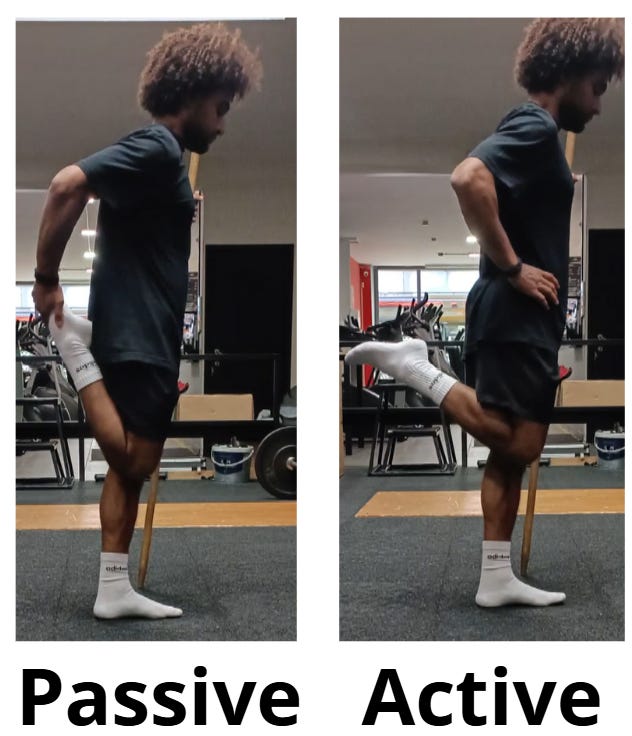
- Passively: You use external help like gravity, a strap, your hand, or someone else to pull yourself into a position.
- Actively: You get into the same position using only your muscles.
This distinction is crucial. In one case, you “own” the position because your muscles can take you there. While in the other, you don’t.
Why does it matter?
In sports and daily life, having access to a range of motion is useless if you can’t control it. Imagine a martial artist who can touch their toes easily in a stretch but fails to throw a high kick because their hips don’t have the active control to reach that height.
Having flexibility without strength in those ranges doesn’t just limit performance but can also increase your risk of injury.
What to do about it?
Step one is gaining enough passive range of motion for your activity (you can check this article for some inspiration).
Step two is closing the gap by developing active control in that range.
The goal is simple: strengthen the motion you already have, so your body feels safe and capable using it.
How to measure the gap?
- Pull yourself into your deepest stretch (passive).
- Try to reach the same position without assistance, using only your muscles (active).
- Compare the two.
Ideally, the difference should be less than 15-20°.
What if the ratio is higher than 15°?
That’s where things get interesting and that’s exactly what we’ll dive into next week.😏